
DID YOU KNOW …? Who really said it?
Okay, that’s enough celebrating for now.
We’ve got my birthday out of the way, and we have the column’s birthday out of the way. Halloween is coming up, but I’m still too exhausted from the previous celebrations to deal with it just yet.
So let’s get into this week’s trivia – and it’s going to be a somewhat different kind of trivia. This week, we’re looking at famous quotes attributed to famous people who actually didn’t say them.
Get ready to have your mind dazzled, folks.
Did you know …
… who said “Keep your friends close, but your enemies closer”? The quote is attributed to the ancient Chinese scholar Sun Tzu (544 BC-496 BC). Known for his work The Art of War, which is still studied by military forces today, Sun Tzu said a lot of noteworthy things – but this isn’t one of them. In fact, the quote comes from the 1974 movie The Godfather Part II, and was spoken by the character of Michael Corleone, played by actor Al Pacino (born 1940). (It’s good advice, regardless of the source.)
… who said “Insanity is doing the same thing over and over again and expecting a different result”? This popular one is said to have been uttered by physicist Albert Einstein (1879-1955), but there is no definitive proof he ever said it or wrote it. In fact, nobody is sure where the comment comes from. (But it’s right.)
… who said “Well-behaved women rarely make history”? Many people think that line came from actress Marilyn Monroe (1926-1962), and it would have been most appropriate if indeed it had. But it didn’t. The line was actually uttered in 1976 by Laurel Thatcher Ulrich (born 1938), a historian. Her work specialized in early America and the history of women, so she should know. (And how.)
… who said “If you can dream it, you can do it”? This line is said to have been the mantra of Walt Disney (1901-1966). However, there’s no actual record of Disney himself saying it. The quote comes from the Disney organization, but it was crafted long after Walt’s death. (Maybe the mouse said it.)
… who said “I disapprove of what you say but I will defend to the death your right to say it”? You might think it was the French writer Voltaire (born François-Marie Arouet, 1694-1778), or possibly Thomas Jefferson (1743-1826). You’d be wrong in either case. The line was actually written in 1906 by Evelyn Beatrice Hall (1868-1956), a British writer and biographer of Voltaire. She wrote it while summarizing his attitude toward free speech. (I many not agree with who said it, but will … uh … never mind.)
… who said “We are not amused”? This classic is attributed to Queen Victoria of the United Kingdom (1819-1901). The pure ice of the line is enough to freeze the worst attempt at humor in its tracks … but Her Majesty herself denied ever saying it, and no written record of the words exist. Nobody knows where the line actually came from, but it probably was derived from her almost humorless image. (We are not … whatever.)
… who said “The death of one man is a tragedy; the death of millions is a statistic”? This rather dark thought is said to have come from Soviet leader Joseph Stalin (1878-1953) but, again, nowhere in his speeches or writings does Uncle Joe ever say it. People who study such things say the words more likely stem from mid-20th Century German writers and satirists. (Truth comes from many angles.)
… who said “You can never cross the ocean unless you have the courage to lose sight of the shore”? Well, I can tell you who didn’t say it, though it is attributed to him – Christopher Columbus (1451-1506). The words appear nowhere in his writings. They do appear, however, in the writings of the man who actually said them, André Gide (1869-1951) a French author. (I don’t cross oceans. I can’t swim.)
… who said “Good artists copy; great artists steal”? If you’ve been following the theme of the column, you know it wasn’t Pablo Picasso (1881-1973), the famous Spanish painter and sculptor who is said to have said it. The idea of the quote comes from numerous artists throughout time, but exactly who codified it in those words is not known. (Great writers do the same thing. Good thing I’m not a great writer.)
… who said “History is written by the victors”? Most people who are familiar with the line think it came from Sir Winston Churchill (1874-1965), Prime Minister of the United Kingdom during most of World War II. But the saying is much older than Churchill, reaching back into the 19th Century. While he may not have said it, he certainly lived it. (With great aplomb, I might add.)
… who said “A penny saved is a penny earned”? That sounds like pure Benjamin Franklin (1706-1790), doesn’t it? And in a way, it was. He used similar wording in his Poor Richard’s Almanac, but it was more along the lines of if you save a penny, you have two. The quote evolved through time to the way we hear it today, but Franklin never put it in those words. (Got a penny? Neither do I – they don’t mint them any more.)
… who said “The end justifies the means”? Most think it comes from Niccolo Machiavelli (1469-1527), a Florentine diplomat, author and philosopher. Nope. The thought may have been based on Machiavelli’s works, but he never wrote that actual line. It developed over time as people read his works and became something he should have said.
Now … you know!
Before you go...
Thanks for reading The Houston Home Journal — we hope this article added to your day.
For over 150 years, Houston Home Journal has been the newspaper of record for Perry, Warner Robins and Centerville. We're excited to expand our online news coverage, while maintaining our twice-weekly print newspaper.
If you like what you see, please consider becoming a member of The Houston Home Journal. We're all in this together, working for a better Warner Robins, Perry and Centerville, and we appreciate and need your support.
Please join the readers like you who help make community journalism possible by joining The Houston Home Journal. Thank you.
- Brieanna Smith, Houston Home Journal managing editor
Paid Posts
Related Articles
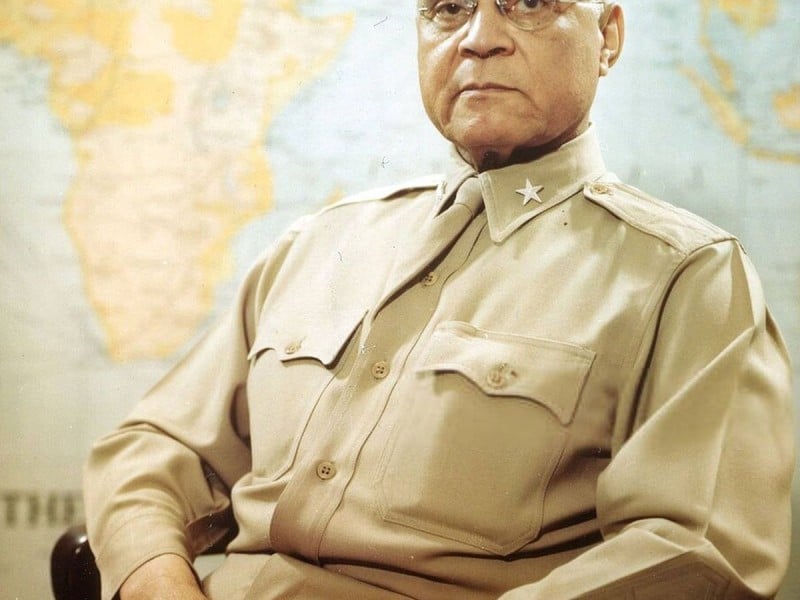
This Week in American History: 1940 – Benjamin Davis Promoted to Brigadier General
This week in 1940, US Army veteran Benjamin O. Davis, Sr. becomes the first black person to achieve the rank of Brigadier General in the US Army.

Andy’s Astronomy: Meteor Shower Peaks Next Week
Put the phones down and go outside.
The ongoing Orionids Meteor Shower is projected to reach peak activity during the overnight hours of Tuesday, Oct. 21 to Wednesday, Oct. 22.

DID YOU KNOW …? Ten Years of Trivia!
I’ve told this before, but it’s definitely worth retelling now.
In October of 2016, I had a problem – I was laying out the newspaper and had a pretty good-sized “hole” on one page, blank space with nothing in the folder with which to fill it.
Remembering my days as a teacher, I recalled the trivia bits I used to post on the classroom bulletin board and thought, “Why not stick some of those in that hole on page six?” or whatever page it was.
The reaction from the readers was immediate and positive, so I made it a column the following week.
That was ten years ago. This week, my little emergency solution turns ten years old, and I am amazed and gratified that it’s lasted so long, and is so popular with you, the readers. Thank you for the last decade of enjoyment that we have both derived from all of this.
Let’s get to the tenth anniversary of trivia right now!